
Massachusetts
EV Charging in Massachusetts -
Massachusetts in 2026 continues to actively support commercial electric vehicle (EV) charging station projects as part of its broader climate and transportation strategy, combining public investment, planning, and regulatory efforts. The Healey-Driscoll Administration has dedicated significant funding toward building out EV charging infrastructure across the state, including making investments aimed at expanding publicly accessible chargers and supporting fleets and municipalities in deploying new stations. This includes programs administered by the Massachusetts Clean Energy Center (MassCEC) backed by American Rescue Plan Act funds that help cover planning, installation, and technical support for on-street and fleet charging solutions—especially in underserved communities. State assessments and coordinated planning by the Electric Vehicle Infrastructure Coordinating Council (EVICC) guide these efforts to create an equitable and connected network through at least 2026.
For commercial and public charging projects specifically, Massachusetts provides a mix of financial incentives and grant opportunities under its Electric Vehicle Incentive Program (MassEVIP) and via utility partnerships. Eligible commercial entities can receive funding to offset the cost of Level 2 and public charging station hardware and installation, with public access locations qualifying for higher coverage levels. Utilities like National Grid and Eversource also offer rebates tied to infrastructure costs for EV charging deployments, which can make commercial station projects more financially viable. Additionally, federal incentives such as the Alternative Fuel Infrastructure Tax Credit (30C) are available through mid-2026 for qualifying commercial charging installations, further reducing upfront costs for businesses that meet eligibility criteria.
Regulatory and policy support complements these incentives. Massachusetts requires commercial EV charging stations operating in the state to register with the Division of Standards by 2026, reflecting efforts to ensure safety and uniform standards as the network grows. The state’s NEVI (National Electric Vehicle Infrastructure) plan also outlines build-out of fast charging corridors to meet federal requirements, with anticipated deployment continuing through 2026. Meanwhile, broader state policy such as EV infrastructure assessments and “right to charge” provisions for multifamily properties signal a positive stance toward facilitating EV charger deployment, lowering barriers, and integrating new charging into communities, workplaces, and commercial districts.
Solar Power in Massachusetts -


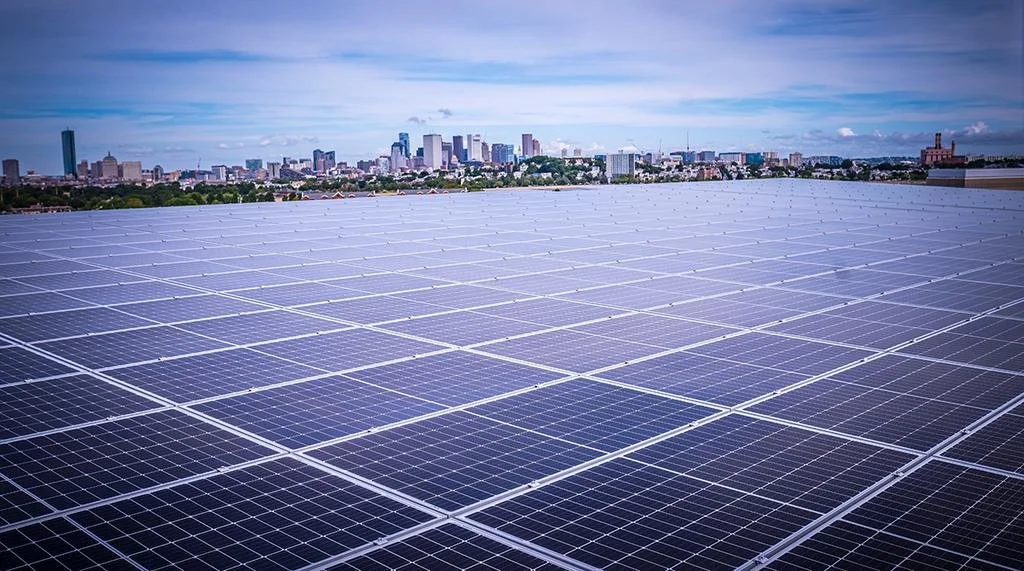
Massachusetts’ support for commercial solar power projects is backed by clear deployment and capacity data. As of 2024–2025, the state had installed over 5 gigawatts (GW) of solar capacity, placing it among the top solar states in the U.S., with solar supplying roughly one-quarter of in-state electricity demand during peak production periods . Much of this growth has come from commercial, industrial, and community-scale projects rather than single-family residential systems, reflecting deliberate state policy aimed at scaling non-residential solar.
State incentives provide concrete evidence of this stance. The SMART (Solar Massachusetts Renewable Target) program, launched in 2018 and updated to SMART 3.0, has supported more than 4 GW of installed capacity across over 140,000 projects statewide, with eligibility extending to commercial systems up to 5 MW (and up to 10 MW for certain project types such as brownfields and landfills) . For SMART 3.0 alone, Massachusetts made hundreds of megawatts of new incentive capacity available annually, signaling continued state investment in commercial-scale solar development rather than a phase-out of support.
Economic and grid data further reinforce the state’s position. Massachusetts’ Renewable Portfolio Standard requires utilities to procure increasing amounts of renewable energy each year, guaranteeing long-term demand for solar generation, while net-metering rules allow commercial projects up to 2 MW (private) and 10 MW (public) to receive bill credits for exported power . Combined, these policies have helped drive billions of dollars in private investment and support more than 11,000 solar-related jobs in the state, demonstrating that Massachusetts’ stance on commercial solar is not just supportive in principle, but measurable in outcomes.