Missouri
EV Charging in Missouri -
Solar Power in Missouri -
Missouri’s 2026 approach to commercial electric‑vehicle charging infrastructure reflects a supportive but market‑oriented stance that combines participation in federal programs, selective state funding, and legal limits on local government mandates. The state is actively implementing its National Electric Vehicle Infrastructure (NEVI) plan under the federal Bipartisan Infrastructure Law, which secures nearly $99 million for EV charging deployment through 2026. This funding primarily targets the build‑out of a connected network of fast chargers along major corridors, encouraging commercial and public charging projects while ensuring Missouri meets federal requirements for interstate and key highway coverage.
At the state level, Missouri has also used Volkswagen Trust Fund grants and other funding streams to support installations of public chargers in partnership with local businesses and governments, helping expand access beyond highways into communities and parks. These state‑level incentives demonstrate a willingness to partner with commercial entities and utilities to grow charging infrastructure without imposing broad regulatory burdens. Utilities like Ameren Missouri have backed programs that provide direct incentives to businesses for installing charging stations, highlighting a preference for voluntary investment and collaboration over prescriptive rules.
Conversely, Missouri limits local government authority to mandate EV charging installations on private commercial properties. In 2024, the legislature passed House Bill 2062, which prohibits cities and counties from requiring businesses, churches, or non‑profits to install a set number of charging stations in new or redeveloped parking lots, reflecting a political stance that favors business discretion and reduced regulatory compulsion in commercial EV infrastructure decisions. While this does not restrict private installation or broader state and federal efforts to subsidize chargers, it signals that Missouri prioritizes market demand and voluntary adoption over local mandates in shaping the commercial EV charging landscape.
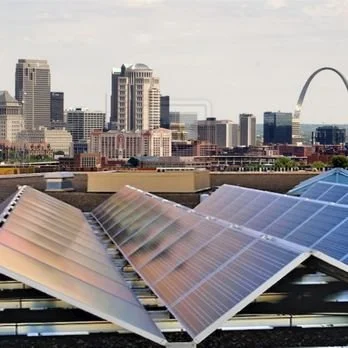
Missouri’s stance on commercial solar power projects in 2026 reflects a mix of ongoing development, emerging regulatory scrutiny, and political resistance. On the development side, several large utility‑scale solar projects are already moving forward or have recently begun operations in the state. Independent developers such as Cordelio Power have brought a 150 MW project online, and major installations like the 430 MW Kelso Solar portfolio are under construction, signaling significant private and corporate investment in Missouri’s solar capacity. Utilities like Ameren Missouri have regulatory approval to add hundreds of megawatts of solar generation by 2026, including projects in Warren County and Bowling Green, which are part of broader efforts to diversify energy sources and meet future electricity demand.
At the same time, the political and regulatory environment in 2026 is becoming more cautious toward new commercial solar development. State lawmakers have introduced bills such as Senate Bill 849 (and a similar SB 933) that would place a moratorium on the construction and permitting of new solar projects across Missouri until at least the end of 2027 while the Department of Natural Resources develops environmental and siting regulations. These proposals, supported by Governor Mike Kehoe, are framed as a way to establish “guardrails” around rural solar development and address community concerns over land use, but they represent a significant slowdown compared with past growth.
Beyond moratorium discussions, the legislature is also considering additional regulatory measures, including requiring decommissioning plans for utility‑scale solar projects and adjusting property tax classifications that affect how solar facilities and associated land are taxed. While some reforms aim to encourage investment by clarifying tax treatment, others reflect broader debates about balancing renewable energy growth with concerns about reliability, farmland preservation, and local impacts. Overall, Missouri in 2026 is at a crossroads, with strong commercial solar projects still progressing but a clear shift toward more restrictive oversight and legislative intervention shaping the future pace of new solar development.